Monday, August 12, 2013

1930's fashion in Agatha Christie's Poirot - part 3


Before starting with a few 1940's posts let's continue the 'Poirot series' with 1930's fashion! The following screenshots are from the Season 6 episode: 'Murder on the Links'. The story is situated in exactly 1933, as a shot of an advertisement tells us at the beginning of the story.
Remember, this is still the period of the 'Great depression' and the Art Deco. Fashion design moved toward simpler lines to reflect the simpler lives of the public. Hats and often gloves complimented almost every outfit. The fabrics were colorful, with flower, dot and striped prints.

Mother and daughter in pastel colored summer dresses. The mother's shirtwaist dress has an asymmetrical closure and a fold-over design. The girl's yellow chiffon dress is romantic, with wide, gathered sleeves and rows of ruffles along the shoulders and the (very 1930's) high waistline:


The maid's dress even matches the wallpaper:


We can see the contrast, while the rich character's dresses aare well tailored the maid's uniform seem to be too big for her:
  

The first appearance of Bella, Capitain Hastings' love interest and future wife!
(This is the only episode we see her, later on when they get married she is abroad and he only talks about her.) The evening he see her for the first time perform, she wears a blue satin gown with sequin-like beading and a matching bolero:


Mother and daughter in pretty prints!


The mother's blouse features pretty ruching details at the front. The print is interesting, looks almost like a novelty print with airballoons.


Later on there is another one-shot-appearance of the dress above where we discover the interesting art-deco motif finish of the skirt!


This dress appears just in one shot, but the pretty details of the buttoned collar are visible. It's a pity we don't get the whole dress to see:

30's bathing suits:
 

A nice shot whit a huge art deco window:


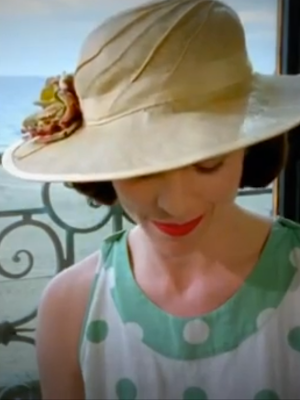
Another summer frock in white and pastel green with buttons at the shoulders and a sash. The hat has pintuck details:


Anther white and green frock with long sleeves, worn with a hat and gloves. The shape of the dresses was tubular or column-like, rather than curved. There is ruching along the shoulders and a lace application:


In a close-up shot we get to see some details of the white lace gloves:


A young lady's hat with a contrasting color ribbon instead of a matching one. Her suits have simple lines as well:


A simple beige suit:
  

Pearl necklaces seem to be the accessory of the 30's. The mother and daughter wear a more modest single strain necklace, the wealthier lady a 3-strain necklace:


The two ladies one in dark, the other in plight pastel colored outfints:
  

Little details like a matching brooch and silk flowers on the hat:


The daughter wears an elegant hat with feathers (a complete wing actually!) and a suit with a very interesting neckline-solution: a scarf in a contrasting color that seems to be an underlayer of the lapels with two ties are pulled through the holes. The mother's suit has no lapels, the collar is marked with buttons:


The poor and the rich. The clothes and the hat of the maid are simple and modest.  She wears no make-up or accessories. The rich lady's outfit is complemented by a matching hat, gloves and a necklace:
  

A light blue (velvet?) suit with a matching light blue organdy blouse:
  

In the close-up we see the button details on the lapels and the jabot of the blouse:


A diner scene with elegant gowns. Even middle class women owned evening gowns:


The seamingly simple black dress is made out of a fabric with a nice texture and worn with a necklace of black beads:


Glass beaded jewellery maches the pale blue gown:


This lady wears mainly dark clothes throughout this episode. The gown she wears at home has a huge rounded collar and the dark cardigan has scalloped edges:
   

She is portrayed in two light coloured outfits in better times:
   

In the final scene Hastings girlfriend wears a wrap-blouse with flutter sleeves and matching pale green, wide-legged trousers (probably an overall rather than separate pieces)


The end... I love this shoot bacause of it's symmetry with horizontal and vertical lines!


For other pictures from the Poirot series click on the banner on the right!
More of 1930's fashion in the 'Miss Lemon wardrobe files' here!

Thursday, August 8, 2013

The 1934 collar en cuff in action!


Here are the pictures! Click here for the original 1934 pattern.
Of course, my version is less 'dramatic' sizewise than the original, but I think it is definitely more wearable. The collar really 'wants' to stay in a circular form, but after starching and ironing it stays nicely in shape:
   

(Sorry for my hair, it wasn't styled yet and I didn't wear make-up either) Though it's not clearly visible, I'm posing with an 1950's book on etiquette from the thrift shop!
Here is the full set on another sweater of mine:


8 ways to combine the pieces:
1. Just the collar:


2. The collar with the bow:


3. The cuffs with the bows
4. A small bow worn as a brooch
   

5. The small bow worn as a brooch in combination with the cuffs
6. The big bow in combination with the cuffs
  

7. The collar and bow worn with the cuffs
8. The set worn as originally designed


Notes on starching: 
Starch was used during the past decades to make household linens and clothes last longer. Especially the most used parts of the outfits like collars and cuffs were treated to prevent staining and weakening the fabric.
Yhe mixture I used is again a kitchen-purpose cornstarch:
Mix 1 heaping teaspoon of cornstarch with 300 ml of cold water and stir until it is completely dissolved. I dipped the cuffs and only the chain edges of the collar. Ironed it at medium temperature (for cotton) not too hot because thet could burn the cornstarch making brown spots.

An 1934 instruction:

Monday, August 5, 2013

Crochet collar and cuff pattern from 1934!


I thought it would be fun to finish the Miss Lemon wardrobe series with a 1930's project, Miss Lemon could make herself!
I turned to my favorite source of vintage magazines, the Australian Women's Weekly again and choose a fairly simple but impressive crochet pattern of a collar and cuffs from 1934. Collars and cuffs were the ultimate accessory to brighten up last years frock as they wrote quite often:
"Here's another of those completely adorable collar and cuff sets that go on and of in the twinkling of an eye so that your best friends never know whether it is the same frock you are wearing so often or not. The set is delightful for a dark frock, and adds that ultra-chic touch of smartness that turns an ordinary dress into a most distinctive one." 
Gauntlets were very fashionable in the early and mid 30's. Already in 1933 a similar crochet pattern was published to make gauntlet attachments for simple fabric gloves:

"Here is another of fashion's irresistible little notions that can be worked at almost lightning speed from an ounce of wool and then attached to any pair of gloves to match your daintiest frocks. White fabric gloves with white crochet gauntlets would look so smart with a black and white outfit. And white tops on beige, brown, or grey gloves would be equally effective."
Bows were an 'inseparable' element of the 'Continental' knitted and crocheted designs in 1933-1934. We know Miss Lemon loves matching cuff and collar sets, so let's imagine she took out the crochet needle in the evenings, after a long day in company of her demanding boss, Mr. Poirot!


"An enchanting little set, comprising collar and cuffs, as sketched by Petrov*. Then you can step forth blithely to work in the knowledge that you are as chic as any girl could wish to look."
* Petrov (also known as Geoffrey Claude Turton) was a cartoonist and magazine illustrator. Petrov regularly contributed to the AWW magazine in the 1930's.
The original collar and cuff ensemble was designed to be larger than mine. I wanted to make a contemporary version which could be worn without appearing 'overdressed'.


Pattern notions:
- I used a metric size 2 crochet needle.
- The size of the finished items may vary by the size and weight of the yarn used. I would recommend to start by making the bow of the collar. This goes quite fast and gives a good idea of the sizing!

Below the big bow, a small bow and cuff (sizes in cm)
   

The finished big bow:


A finished small bow:

- To make a larger collar add a multiple of 2 chains to the starting row of chains.
- If you don't use mercerized cotton yarn you may expect about 5-10% shrinkage! In order to avoid an unusable small sized set you should make the pieces slightly larger: add some length to the desired cuff circumference and collar length.
What is Mercer cotton? In 1851, John Mercer (1791-1866) found a way to increase the luster of cotton by adding caustic soda, sulfuric acid and other chemicals to the fiber. By altering the cotton, it was found that it didn't shrink as much when washed and took dye more readily. Mercerized cotton is also more mildew resistant than standard cotton fiber and has a softer appearance and feel.
My pattern modifications:
  • For both the collar and the cuffs less chain rows were made (collar 12 rows, cuff 11) The original 18 and 16 rows seemed a bit overwhelming, I felt less rows would give a nice balance for the bows. My bows are made as described in the pattern. For the collar I made 3 rows of 4 ch, 4 rows of 5ch and 3 rows of 6 ch. For the cuffs 6 rows of 4 ch and 5 rows of 5 ch.
  • Size of collar: I increased the chain length of the collar. The 110 chains of the pattern formed a length too short to make a nice v-neck.
  • Picot's: I used slipstitch instead of d.c. to make the picot's, because that's the way I learned it and it makes the work look finer too i.m.o.
  • Edging bows: The bows are made with smaller, 3-chain loops, so 2x3 d.c. as described for the collar was way too much. I used 2 d.c.-picot-2 d.c. instead.
  • Edging cuffs: Again, I used the 2 d.c.-picot-2 d.c. edging for the loops and loop edges (picture below left). This gives a neat finish. I found that the 3 d.c.-picot-3 d.c. stretched out the edges of the cuffs too much
   

The crochet terms used in the original pattern are the UK terms. Interestingly, another crochet pattern I found in the AWW used the US terms. Getting confused? I certainly was, but the picture and crocheting a test piece helped.

The abbrevations used in the pattern and the corresponding US terms:
ch. = chain
d.c. = single crochet
treble = double crochet
For more explanation of UK and US crochet terms click here.
  
This pattern appeared in an 1934 issue of the Australian Women's Weekly magazine. All original newspaper images through Trove, all other images are mine.

Notes on finishing:
- After reading the pattern descriptions I wondered where the press-studs should be placed, where the small bows should be sewn and whether I should finish all of the edges of the cuffs or the sides should be attached first. I guess those days these things were more evident to the readers than now. As far as the edges of the cuffs go, the pattern doesn't mention crocheting round or sewing the sides together (though it seems like there are no visible edges on the picture) so I choose to finish the sides and upper edge with the picot motifs. I attached the bows in the middle of the cuffs, just on the last two rows of the treble stitches.
- I didn't used press-studs, planning to handsew the collar and cuffs to the sweater instead. It can be easily removed before washing.
- It can be handy to attach the bows separately with small safety pins. That way they can be easily removed, washed and starched again. Besides that the bows can be worn separately as a brooch.
An advice from the AWW's 'Miss precious minutes' series: 
"Attach white touches by tacking or fastening by tiny gold safety pins, then they can easly be removed and laundered."
- Starching of the finished collar, cuffs and bows before finishing (=assembling bows) is necessary! The lace loops won't stand in place on their own. Iron everything on a thick towel with the right side down to keep the surface structure intact.

To see my finished set in action click here!

Friday, August 2, 2013

Treasures from the found sewing box!


A few weeks ago we've found an old sewing box on the street. In the meantime I had the chance to take pictures of the contents. I listed a couple of interesting items below:

Stocking darning kit
The little piece of cardboard contains two colors of really thin, but strong, silky thread: one pinkish 'flesh' color and one more brownish shade. This might be the oldest thing in the sewing box, since nylon stockings were almost exclusively worn from the 1950's on. Thicker nylon stockings of the early days could be repaired by picking up the stitches with a thin crochet hook, but nylon was just too weak to be mend over and over again.


CARP thread on wooden spools
We don't use wooden spools anymore, it's all plastic now. 'Carp' was the name of a dutch textile industrialist in the south of the Netherlands between 1900 and 1969. In 1938 the fabrics were bought by the Scottisch J&P coats from Glasgow. They lost the business in the 1960's when cheap work of the low fair countries came up. The wooden spoons are made carefully, the edges are smoothly rounded.


Nickel silver purse frame with handle
It is marked as 'alpacca' - a metal alloy of copper with nickel and zink. It has a silvery metallic color although it doesn't contains silver. Was popular to use to make coins, parts of musical instruments. Nickel silver was first known and used in China. In 1823 a German competition was held to perfect the production process: the goal was to develop an alloy that possessed the closest visual similarity to silver. The brothers Henniger in Berlin and Ernst August Geitner in Schneeberg independently achieved this goal. The manufacturer Berndorf named the trademark brand 'Alpacca', which became widely known in northern Europe for nickel silver.


Old metal cigar boxes
A collection of mending wool for socks was kept in cigar boxes. The metallic boxes are from the dutch make 'Willem II' founded in 1916. In 1977 the fabric was taken over by the Consolidated Cigar Company and by the end of the 1980's the Swedish Match.

This one was produced between 1930-1970:


This one was produced between 1920-1970:


As an extra, a family piece from my own great-grandmother:
Wooden sock darning tool
This wasn't part of the sewing box, but I've got it from my grandma. It was her mother's, like my old Singer sewing machine. A well-used little thing with a lot of fine scratches from frequent use. You often see egg-shaped and sometimes mushroom-shaped darning tools which were used for mending wool socks and stockings. Of course, nowadays we throw away our used socks and buy new ones, but it wasn't the case in the first half of the 20th century when socks were handmade of wool and one owned a limited amount of pairs. They even sold mending wool for socks in the same colors for this purpose (There were a couple of those in my found sewing box too...pic below)